Monday, December 12, 2011

JCM Steam Water Properties

SWP.exe is a standard interface for the calculation of thermodynamic and transport properties of fluids. This software program was developed around 2007 - 2011 (aerryawan gerry), Energy Section, PT. Jaya CM.

Each thermodynamic library implements one or more thermodynamic models for several thermodynamics Analysis and optimization heat and electricity production system

State functions for water/steam calculations are: IAPWS Industrial Formulation 1997 (IAPWS-IF97)

Friday, November 11, 2011

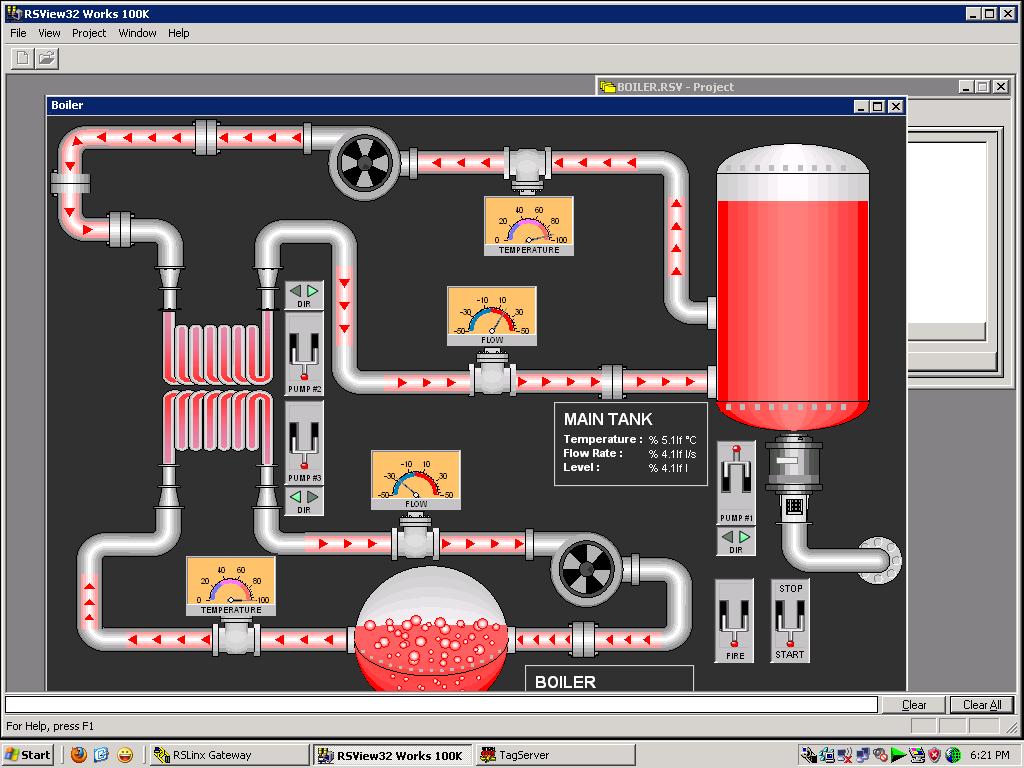
Boiler

Small actifities post cardia surgery. Boiler HMI using RSView32, porting from WinlogLite and Symfac 2.0 to GFX graph, rewrite all tags / derived tags. All tags type converted to DDE tags. RSLinx role as DDE server ;)

Monday, October 10, 2011

Losses in a Transformer

The Efficiency of the transformer is the given by

(Power output/Power Input)*100

The Efficiency of the transformer is affected by the losses inside the transformer.

These losses can be categorized into three types
  1. Copper losses
  2. These are losses caused by the heating of the conductor when current is passes through it. They are also known as I*I*R losses as the heat generated is proportional to the formula H=I*I*R

  3. Core Losses
  4. Core losses are the losses which occur in the core of the transformer. There are two kinds of core losses, They are Hysteresis Loss and Eddy Current Losses

    • Hysteresis losses occur when the magnetic orientation of the molecules inside the core are reversed when the magnetic field changes. This reversal of orientation of the molecules results in the generation of heat.

    • Eddy current losses occur due to circulating currents in the form of eddies which are generated in the core. These eddy currents generate heat.

  5. Stray losses
  6. These are losses which occur due to the leakage of the magnetic flux of the transformer. This leakage can cause eddy currents in the fitments of the transformer such as the tank, channels, bolts, etc.

Monday, September 12, 2011

The combustion Losses in Boiler

When the fuel is burnt in the furnace of a boiler, all the energy in the fuel is not available to heat the boiler. Some of the energy is lost in the form of losses.

The Losses in combustion of a boiler are categorized in to the following types:
  1. Loss in the Flue gases
  2. The heat generated by burning the fuel is present in the flue gases. When these gases escape into the atmosphere, some amount of heat also escapes with the gases.

  3. Hydrogen Losses
  4. This refers to the heat used in evaporating moisture or water present in the fuel. This is particularly significant in coal-fired boilers.

  5. Losses due to improper combustion.
  6. The improper combustion of fuel due to poor quality or inadequate air also results in loss of potential energy

  7. Losses due to Convection and Radiation
  8. The furnace of the boiler is insulated. Despite this, some heat escapes from the furnace to the atmosphere.

Monday, August 8, 2011

Draught in Boilers

Draught or Draft refers to the pressure difference between the burner and the atmosphere. This pressure difference or draught causes the air to flow from the burner to the atmosphere. The residue of combustion such as waste gases, soot, etc are carried away by the flow of air.

Draught also has a great role to play in combustion. The flow of fresh air into the burners is necessary for proper combustion. Hence, the draught system should be designed such that the combustion can take place properly.

The draught of a combustion system can be measured using a manometer when the furnace is in operation. One end of the manometer is connected to the furnace while the other end is left open to the atmosphere. The pressure difference indicates the draught of the system.

There are different types of draught:
  1. Natural Draught where the draught occurs naturally due to the pressure difference between the furnace and the atmosphere.
  2. Induced Draught where the draught occurs by means of fans which create a negative pressure in the furnace causing fresh air to enter
  3. Forced Draught where the draught occurs due to fans which provide combustion air and create a positive draught in the furnace. This drives the air through the chimney

Thursday, July 7, 2011

Hammering in Boiler Systems

Water present in a steam system moves at a very high velocity driven by the steam pressure. In some cases, the acceleration is even greater than that of steam. When this water at high speed hits a fitting such as valve or a bend, violent impact resulting in noise or a pressure shock which travels through the system is produced. This is called water hammering

Mild cases of water hammering can cause noise or vibration. Extremely severe cases can result in fracture of the pipe.

Condensate Hammering is more damaging than water hammering. In condensate hammering, a pocket of steam surrounded by cooler water condenses into water. This causes a rapid reduction in volume. The water surrounding the pocket are thus drawn inwards and a collision occurs. This results in a severe a rapid over pressurization which can easily damage gaskets, valves and other components. The consequences can be very disastrous even fatal.

Hammering can be removed by preventing water from entering the steam lines. Reducing Carryover, ensuring that the steam traps are functioning properly are some of the precautions. The steam velocity in a boiler should not be allowed to exceed limits. Steam velocity has a direct bearing on the intensity of the hammering.

The piping should be as per design. Sagging of the pipeline can cause water hammering. Damaged insulation can cause condensate formation in the pipelines. Insulation should be checked and replaced if damaged.

Monday, June 6, 2011

Membrane Contactors

Membrane Contactors are used to deaerate water in a boiler. Membrane Contactors are getting increasingly popular. Membrane Contactors use a membrane which is made of hydrophobic material with pore size of the order of 0.03 micrometer.

On one side of the membrane, a gas, usually nitrogen, is passed at low pressure. On the other side, the water to be deaerated is passed. Since the membrane is hydrophobic, the water does not pass through it. But the gases which are dissolved pass through the membrane to the other side with low pressure.

The deaeration process can be controlled by varying the pressure of the gas and its concentration. The capacity of the contactor can be increased by adding more membranes. The membrane contactor method can produce water with a dissolved oxygen concentration of less than 1 ppb (parts per billion).

The advantages of using Membrane Contactors are:
  1. Absence of Emulsions
  2. No Flooding even at high flow rates.
  3. No density difference between the fluids is required.
  4. High surface areas

Thursday, May 5, 2011

Deaeration of Boiler Water

Deaeration refers to the process of removing dissolved gases such as oxygen and carbondioxide from the water. Dissolved Oxygen in Water causes corrosion by the formation of rush on the surfaces of the boiler and the piping (rust). Carbondioxide which is dissolved in the water forms carbonic acid which also causes corrosion.

Hence, it is essential that these two gases are removed from water. Deaerators can be classified into:

  1. Mechanical Deaerators:

  2. These Deaerators separate the gases by a mix of high temperature and mechanical action

  3. Chemical Deaerators:

  4. Chemical deaerators work by passing the water through chemicals which absorb the oxygen and the carbondioxide.

  5. Vacuum Deaerators

  6. Membrane Contractors:

  7. Membrane Contractors work by passing the water through hollow fibres. The water is made to pass on the outside of the hollow fibre. A vacuum is created on the inside. The gases pass through the membrane on to the inside and drawn into the vacuum pump.

Monday, April 4, 2011

The Day the Rankine Closed


Sebuah catatan reflektif seorang thermal engineer yang kini menjadi Kepala ICT

Suatu masa di 2011 . . .

Setiap perjalanan insinyur dimulai dengan noise. Di hari-hari awal, diagram T–s tampak seperti peta yang menolak bersahabat: garis keluaran turbin meloncat ke udara, superheating tidak pernah menapak pada kondenser, dan enthalpy inlet–outlet tidak pernah menutup sempurna.

Setiap titik menjadi tanda tanya. Dan setiap kali tombol Run ditekan, PC Desktop mengingatkan dengan dingin:

“Energy balance not achieved.”
Namun yang tidak dikatakan oleh software itu adalah — kesabaran juga bagian dari perhitungan.


1. Fase Debug — Menyelami Jalur Energi

Hari-hari itu saya habiskan di antara angka dan keringat. Satu per satu node saya buka: feedwater heater, deaerator, low-pressure heater. Saya periksa mass flow, saya tetapkan nilai xoutlet di sisi kondensasi. Tidak ada yang instan di dunia termodinamika. Bahkan energi pun, sebelum berpindah, harus berdamai dengan tekanan dan suhu sekitarnya.

Perlahan-lahan, titik-titik itu mulai berbicara. Saya mulai mendengar pola — bukan lagi angka, tapi ritme: bagaimana uap memberi panas, bagaimana cairan menerima, bagaimana setiap kilojoule kembali ke asalnya tanpa tersesat.


2. Fase Penutupan — Kesempurnaan yang Sunyi

Dan akhirnya, di suatu sore, setelah sekian jam iterasi, saya menatap layar dan melihat garis itu menyatu: kurva uap yang turun lembut ke garis jenuh cair. Tidak ada perayaan besar — hanya keheningan, dan sebutir kepastian kecil: bahwa hukum pertama termodinamika telah ditegakkan.

GPHR dan NPHR kini punya makna, bukan sekadar angka di laporan, tapi cermin dari keseimbangan — antara energi yang keluar dan energi yang pulang. Itu hari ketika siklus Rankine saya menutup sempurna. Dan di momen itu saya sadar:

“Siklus ini bukan sekadar mesin,
tapi alegori tentang kehidupan.”

3. Epilog — Dari Uap ke Data

Kini saya tidak lagi menghitung kalor, melainkan bit, bandwidth, dan uptime. Namun setiap kali saya melihat arsitektur jaringan yang stabil, saya masih melihat siklus Rankine di baliknya: Server sebagai boiler, router sebagai turbin, database sebagai deaerator, user sebagai kondenser. Dan di pusat semua itu, ada hukum yang sama:

Tidak ada sistem yang sempurna,
kecuali yang seimbang.

Dulu saya menyeimbangkan uap dengan air; sekarang saya menyeimbangkan manusia dengan mesin. Dan saya tahu, prinsipnya tidak pernah berubah.


Penutup

Sempurna bukan berarti tanpa kehilangan, tapi ketika semua kehilangan telah kembali menjadi energi lain.

Begitulah hidup seorang insinyur — selalu berputar, selalu menyeimbangkan, dan selalu berharap, setiap siklus yang ia rancang menjadi sedikit lebih selaras dengan Sang Pencipta Energi itu sendiri.

— Chief-ICT, JCM
(engineer termal yang masih percaya bahwa setiap siklus, termasuk kehidupan, harus ditutup dengan keseimbangan)

Thursday, March 3, 2011

It is simply beyond our senses, thought, logic, and comprehension

As reiterated time and again by those brilliant brains, this invented supreme creator is simply beyond our senses, thoughts, reason and comprehension. We are the lowly creatures, with a limited capability to understand the creation and existence. If this is the truth, then why do we keep trying to understand it? There are much more productive areas to direct our efforts which would produce results.

The results, expected from the research in genetics, and especially the human genome project will provide us with tremendous possibilities to raise our level of intellect towards that of the supreme creator(!). This will put us in a position to understand how the mankind has duped itself. These scientific developments will show us also a much more clear picture of our existence than the debate on the supreme creator.

Wednesday, February 2, 2011

Intellectual Efforts To Prove The "UN-Proveable"

Since its invention by the human imagination this has been a matter for the resolution of which a great deal of intellectual resourcefulness has been put to trial. Problem was and still is to find an explanation to the inexplicable, and proving the un-provable. It is boring in the sense that there is no end to it. It is definitely not of this world because no one has seen or heard or witnessed anything about the supreme being, that could bring a pinch of reality to it. All efforts have been fruitless since its inception 6000 years ago, but nevertheless it continues to be the most favorite pastime of the incognizant minds. The ideas invented by the mankind and the belief systems built around those ideas have been the source of many problems both in the personal and public spheres. They are the instruments of sovereignty, division, oppression, and injustice as well Since the beginning belief systems have also pushed women into a secondary position in their respective communities. Look around yourself and you'll most certainly come face to face with the characteristic examples.

The brightest brains were involved in the debate to solve the mystery. To no avail. The crucial questions asked thousands of years ago are still valid, and unanswered. Those brains that took part in the discussion have made themselves fall into the trap set up by the inventors of this fiction. Some of them have tried to prove that this invention has really existed while others have tried to show that it is all nonsense. There are always different sides in a discussion. But if the subject of the discussion is an 'unknown' how could one be for or against it positively? We shall not fall into the same trap of discussing the incomprehensible with the terms set by its inventors. This is especially crucial when one remembers all those brilliant brains which were stalled by the stalemate, ending up in rejecting the invention itself. We shall ask the right questions. Each question will show that not even a single step has been taken towards the supposed reality. But too many things have been said and written. As we try to follow the story of the supreme being we shall have glimpses of the frail human mind's efforts to solve the riddle that it has created.

This problem was introduced by the human beings, was it not? Now the ones who are trying to find a solution are also the human beings: Allegedly the limited, the incapable creatures of supreme being. Being limited by creation and incapable of full comprehension of the reality, the mankind felt that it needed answers to the questions about the creator it has invented. The next step was the need to establish the nature, intentions and activities of this creator. This, in turn, has introduced the following crucial questions:

  • Why did this supreme being create the mankind?
  • What is the (imaginary) role given to mankind by this supreme being?

All these efforts ended up in the fall of the mankind to the level of incapability, and the slowing down of the human progress. Thanks to the tremendous achievements in science and technology, situation has changed, and the movement is gathering pace.

Saturday, January 1, 2011

Firmware Kesadaran dan Ritual Kopi Pagi

(Catatan Chief-ICT di bawah cahaya neon kantor)

Setiap pagi, ada dua proses booting yang berlangsung bersamaan: yang satu di dalam server, dan yang satu di dalam kepala manusia. Keduanya sama-sama membutuhkan waktu, listrik, dan kopi. Bedanya, server tak punya pilihan, sementara manusia punya tombol snooze.

⚙️ I. POST — Power On Self Test

Saat mata terbuka setengah, tubuh menjalankan diagnostic sequence. Apakah ini hari kerja? Apakah aku masih hidup? Apakah alarm itu nyata? Dan di titik inilah kesadaran mulai muncul — bukan dari sinar matahari, tapi dari sinar layar ponsel yang menampilkan notifikasi tak berujung.

System check: OK
Wi-Fi: Reconnecting...
Motivation: Missing driver
Mood: Needs caffeine injection
☕ II. Initializing Caffeine Interface

Tak ada protokol yang lebih universal di dunia profesional selain: kopi pagi. Kopi bukan sekadar minuman, tapi ritual sinkronisasi antar dimensi. Di antara kepulan uapnya, Chief-ICT menemukan waktu untuk introspeksi: berapa tiket IT yang belum direspon, berapa RAB yang belum disetujui, dan berapa vendor yang akan datang tanpa janji lalu minta rapat pagi.

Kopi adalah API antara dunia mimpi dan dunia kerja. Ia menyalakan port “kesadaran” dan membuka socket komunikasi dengan realita.
💻 III. System Online — Masuk ke Kantor

Begitu badge di-scan dan pintu terbuka, firmware kesadaran berubah menjadi OS penuh. Wajah-wajah rekan kerja bermunculan seperti ikon desktop: Finance.exe, HRD.bat, VendorUpdate.cmd, dan BoDMeeting.iso. Setiap klik adalah potensi crash, setiap sapaan bisa menjadi patch yang menunda kelelahan.

“Selamat pagi, Pak.” — “Pagi. Sudah di-approve ya RAB yang kemarin?” Dan begitulah, debugging dimulai bahkan sebelum kopi habis.
🔧 IV. System Maintenance — Di Bawah Cahaya Neon

Ketika malam datang dan kantor kosong, hanya satu makhluk yang tersisa: Kepala ICT yang masih menatap layar sambil berkata lirih, “ini bukan lembur, ini maintenance spiritual.” Ia sadar — sistem boleh auto-update, tapi manusia tidak.

Setiap baris kode adalah doa kecil agar dunia tetap stabil.
Setiap log error adalah pengingat bahwa bahkan mesin pun butuh pengampunan.
🌙 V. Shutdown Sequence

Dan ketika lampu neon padam, dan kursi diputar perlahan, Firmware kesadaran kembali tidur, menunggu panggilan alarm besok pagi. Semoga patch hari ini cukup untuk memperbaiki bug kemanusiaan yang tersisa.

System shutting down…
See you again, Monday morning.
Hopefully after only one snooze.

Sunday, December 12, 2010

When Did History Begin?

You must have heard the statement that 'history has begun at Sumer.' The evidence we have today indeed show that it actually had begun between 4000-1000 BC.; If history had started with writing then the first page was written in Mesopotamia about 6000 years ago!

Sumerians started keeping record of their times in the form of pictograms on clay tablets, and around 3000 BC. a form of cuneiform writing and a full syllabic alphabet appeared. Peoples in the neighbouring lands has adopted, amended and used this alphabet according to their needs.

Thursday, November 11, 2010

sparks of reflection

Do you know why the windshield of a car so big and rearview mirror of a car so small? Because our PAST are not as important as our FUTURE. Look to the future and move forward!

Sunday, October 10, 2010

Superior Beings aka Out-of-this-world entities, so called "divine" beings

They are "superior" because human beings consider themselves inferior and powerless in the face of the natural phenomena almost all of which either originate from the skies or the result of atmospheric events. Sky is "up there." The force of aerial phenomena is "overwhelming."

There must be "something" or "someone up there doing all this to the earthlings living down on the earth." Furthermore the earthly phenomena like earthquakes, volcanoes, eruptions and subsidences, possibilities, probabilities and chance all come together and create this idea of "superior beings."

Thursday, September 9, 2010

At the root of faith we have incomprehensibility, perplexity, obscurity, ambiguity, mystification (choose the one you please)

Those who wrote down the rules of the faiths did it intentionally. What did the believers do? They just believed, and they still do, because none of the supposed facts of faith is clear. So the believers had no choice but to take the stories for granted. They had no choice because they needed something and the faith has provided for their needs. They had no choice because the whole thing was an enigma, and the best thing seemed to be to believe without questioning.

Sunday, August 8, 2010

Manifold


Manifold is an object that has no end or limitation but not an infinity, but closed like a globe shape and has no sharp curves or surfaces. Which are algebraic manifolds, is also the geometry objects that can be expressed in the equation. Simple illustration: x²+ y² = 1 is a circle, while xy = 1 is a form of hyperbola.


Wednesday, July 7, 2010

Smart Valve Control

another smart valve control, using microsoft visual basic 3.0 and electronic interfacing. Well, I build this model (1998) using stepper motor (for valve control) and LDR for sensing the fluid inside the tank.

Sunday, June 6, 2010

Are you sure what you know is right?

What is the western perception of primal religions? What do you know about these primitive societies and their beliefs? Let's find the answers by citing those examples (The Elements of World Religions, Liz Flower) which will take us on our road to the sole God: The popular belief is that primal religions are animistic, ancestor-worshipping, sacrificial, fetishistic, ritualistic, shamanistic, superstitious, and polytheistic. But the truth is rather different.

Most of these tribal and primal societies have a very strong social structure. And much of their religion is based on that structure. Dignity in life and death is paramount. Morality is conformation to traditions. Everything has a particular reason, everything has its place. They have a surprising tolerance. Most communities recognize that their belief is theirs, and do not necessarily involve the community next door. There are differences of course. We come across a plurality of beliefs, myths, cosmologies and rituals.

The bottom line is: There is a strong social structure.. Religion is based on that structure.. Dignity is paramount.. Everything has its reason.. Everything has its place.. There is tolerance to other beliefs.. Everything sounds more natural and simpler than today.

Which is better? Today's speculation and ambiguity or their simplicity?

Although there are great differences, the primal religions worldwide have originated from a half dozen basic beliefs. Majority of the primal religions are monotheistic. Surprised? All of them have a fundamental belief in the power of spirits. There is ancestor worship/reverence in the majority of primal religions. A kind of prayer, gifts, and sacrifice exist in most of them. There are also a medicine man and a shaman or a witch doctor. Lastly, majority of these primal religions have celebrations of a new season or a new year.

Wednesday, May 5, 2010

I miss this things

what an old 6200 mix_plant in the new old face RSLogix :)
First time I wrote the program using AI 6200 Logistic, paired with WinLinx and RSView32 back in 1997 — running on a Windows 95 box that hummed louder than the panel cabinet itself. Every rung, every coil, every timer was typed line by line, no drag and drop, no tag browser. Just pure ladder logic and patience.

In those days, uploading to a PLC-5/40E felt like talking to a living thing. When the RUN light blinked steady, it meant trust. When the outputs latched without fault, it meant pride. And when the whole plant came alive — pumps roaring, mixers humming, the mimic diagram dancing green and red — that was the sound of achievement.

I remember carrying a long serial cable, connecting to the processor through DF1, and holding my breath each time "Comms Initialized" appeared on screen. There were no cloud backups, no version control — only floppy disks labeled by hand and the quiet faith that Mr. Never Fail would live up to his name.

Seven years later I reopened the same project in RSLogix, RSLinx and RSView. It was like meeting an old friend wearing a new uniform — the same logic, same heartbeat, but wrapped in a Windows UI. I think no one remember about old AI 6200 Ladder Logistic anymore, but for some of us, those green lines and square coils still whisper stories of the factory floor — of engineers who coded with patience, coffee, and courage.


EDITORIAL NOTE 2025:

This editorial note was written thirty years after the first rung compiled. When logic met learning, and code found consciousness.


In those silent years between relay hums and AI prompts, the language of control never truly changed. It only learned to dream. What began as ladder rungs — drawn with patience, current, and purpose — has now become a living syntax that flows through neural networks. Yet beneath all the abstraction, the rhythm is still the same: input, process, output.

Back then, engineers spoke to machines with timers and coils; today, we speak through algorithms and embeddings. But both are acts of trust — that somewhere within the circuitry, logic will awaken and obey. The console may have changed, but the devotion remains.

This note marks not an ending, but a resonance — a quiet echo from the age of AI 6200 Logistic to the dawn of artificial intuition. The same faith that powered a PLC-5/40E still hums within today’s silicon minds. Only the interface has evolved — from rungs to reasoning, from logic to learning.

— Written in 2025, by an engineer who still believes that even in the age of AI,
every line of code is a conversation between man, machine, and memory.


When Ladder Met AI

It has been decades since I last opened that old mix_plant project. The smell of flux solder, the hum of a 24VDC bus, the flicker of a CRT monitor — all still alive somewhere inside my memory. Back in 1995, I wrote my first complete control program using AI Ladder Logistic 6200, a DOS-based world where every rung was typed like a prayer, and every compile felt like lighting a candle for the machine to understand.

By 1997, I migrated everything to the all-Windows environment using RSLogix. It felt like civilization itself had taken one bold step forward. The gray screens turned to color, the ladder symbols glowed smoother, and my old PLC-5/40E stood proud, breathing through WinLinx and RSView32. I didn’t know it then, but that was the beginning of my own digital awakening.

Those were the days when automation was an art form — not drag-and-drop, but discipline and instinct. I still remember mapping input bits to production databases, linking process variables into Planning Production Control, and writing early GUI panels so that the Control Room could speak to the Directors’ Office upstairs. Each connection was a bridge between worlds: the noise of relays below, and the quiet hum of decision-making above.

We didn’t call it IoT back then. We just called it “making things talk.” The PLC spoke to the PC, the PC spoke to the operator, and somehow — through logic and patience — the entire plant listened.

Now, in the age of cloud and AI, I sometimes open that same ladder again. It still compiles. It still runs. Only now the hum of the processor is replaced by the whisper of a neural net. But deep down, the feeling is the same — that quiet pride of giving structure to chaos, one rung at a time.

— Written by someone who still believes that Ladder Logic is not just code, but poetry drawn in electric lines.