Friday, October 10, 2014

Small Scale CFSPP Load Flow Analysis

In this study, a graphical single-line diagram (SLD) was constructed to represent the electrical network of a small-scale Coal-Fired Steam Power Plant (CFSPP). The diagram integrates both overhead and underground cable systems, allowing comprehensive modeling of the entire distribution network.

The analysis scope included:
  • Load Flow Calculation – Determining active and reactive power distribution across the system, identifying voltage drops, and assessing network efficiency.
  • Short-Circuit Analysis – Evaluating fault currents for various fault scenarios to ensure protective devices operate within safe limits.
  • Motor Starting Studies – Assessing voltage dips and system stability during large motor energization.
  • Transient Stability Simulation – Examining system response under dynamic disturbances.
  • Protective Device Coordination – Verifying settings to ensure selective and reliable fault clearance.
  • Cable Derating Assessment – Applying temperature, grouping, and installation condition corrections to cable ampacity.

All circuit element properties—including transformers, circuit breakers, cables, and loads—were directly editable from the single-line diagram or underground raceway interface. This streamlined design allowed real-time calculation results to be displayed on the diagram itself, providing immediate visual feedback for engineering decisions.

Interpretation of Load Flow Results

The single-line diagram reflects real-time electrical parameters at each major node in the system, allowing direct insight into the operational performance:

  1. High Voltage Bus (HV Bus)70 kV, 1600 A, 31.5 kA
    • Acts as the main distribution backbone for the plant.
    • Load flow shows 99.7% efficiency, meaning voltage drop is minimal.
    • Reactive power compensation is visible with kvar values near zero balance.
  2. Step-Up Transformer (7.2 kV → 70 kV)
    • Responsible for transmitting generator output to the HV grid.
    • Load at secondary side: ~9940 kW, 6160 kvar.
    • Transformer loading is within safe operating range.
  3. Generation Unit12 MW nominal capacity
    • Actual load recorded: ~11310 kW (≈94% of nominal).
    • Reactive power demand: 7998 kvar, managed by system capacitors.
    • Generator operates at ~99.9% voltage regulation, indicating stable excitation control.
  4. Auxiliary Transformer (UAT) 1121 kVA
    • Supplies plant auxiliary loads (lighting, pumps, control systems).
    • Efficiency ~99.8%, minimal losses.
  5. Bus and Feeder Segments
    • Each segment annotated with MVA, MW, and Mvar readings, plus efficiency %.
    • Any percentage <98% would be a red flag for excessive voltage drop or line loss.
    • In this case, all readings are ≥99.7%, meaning system is well-balanced.
Key Findings
  • The system is optimally designed for its load profile, with high efficiency across all buses.
  • Reactive power flow is well-managed; kvar values are within compensable limits, reducing the risk of low power factor penalties.
  • Cable loading and bus voltages confirm that no part of the network is overstressed.
  • The single-line diagram doubles as a live dashboard—both a documentation and monitoring tool.

Tuesday, September 9, 2014

Software Data Conversion Techniques

One of the great advantages of a digital computer, when used in the application of instrumentation and control (I & C), is the ability to replace routine software (programming) for hardware logic. This becomes very interesting if the software logic can be done in time to death on the computer. Many computers will Loaf with doing little or nothing most of the time. With skillful manipulation of interrupts and the right programming, I can often adjust computer to perform logical operations that should be a hardware problem.

Software approach is also sometimes more efficient than hardware.I can change the program at will by reprogramming the memory (ROM) chip is read-only. To make major changes in hardware requires a bit more effort, including the possibility of redesigning the printed circuit board (PCB) and the chassis wiring scheme. I also get the flexibility to have "universal machine" of a computer.

I could make a standard single-board computer or a universal system board mating with a common motherboard that will be used in a variety of different projects. Some companies make single-board computer based on the popular microprocessors. This board has some limited RAM and usually around 2K bytes of ROM on board.

By using the data, address, and the I/O buses, the designer can press into service the same board in a dozen different applications. The same computer board, loaded with different programs in ROM, will perform different functions.

"Microcomputer Interfacing Handbook: A/D & D/A" by Joseph J.Carr, first edition 1980, chapter 16th

Friday, August 8, 2014

Handbook of Microcomputer Interfacing: A/D & D/A

One of my old collection: the book "Microcomputer Interfacing Handbook: A/D & D/A" by Joseph J.Carr, first edition 1980. I was surprised that the book is still in one of my bookshelves and in excellent condition.

Hardcover: 350 pages
Publisher: Tab Books; 1st edition (1980)
Language: English
ISBN: 0-8306-9704-7
ISBN: 0-8306-1271-8 (pbk.)
Product Dimensions: 8.3 x 5 x 1.2 inches

Monday, July 7, 2014

CBTC in different Perspectives

A CBTC system is a "continuous, automatic train control system utilizing high-resolution train location determination, independent from track circuits; continuous, high-capacity, bidirectional train-to-wayside data communications; and trainborne and wayside processors capable of implementing Automatic Train Protection (ATP) functions, as well as optional Automatic Train Operation (ATO) and Automatic Train Supervision (ATS) functions."

Friday, June 6, 2014

The Thermodynamic analysis on small scale coal-fired steam power plant using visual basic

Thermodynamic Analysis on a Small-Scale Coal-Fired Steam Power Plant (Visual Basic Implementation)
“The universe cannot be read until we have learned the language… It is written in mathematical language, and the letters are triangles, circles and other geometrical figures… Without these, one is wandering about in a dark labyrinth.”
— Galileo Galilei (1564–1642)

Overview
This note documents a compact Visual Basic application I built to perform thermodynamic performance analysis and simple optimization for a small-scale coal-fired steam power plant (CFSPP). The goal: provide engineers with a fast, transparent calculator that mirrors the way we think in a single-line heat-balance diagram, not a black box.

Model and Methods

  1. Working fluid: water/steam properties from IAPWS-IF97 (Industrial Formulation, 1997).
  2. Cycle blocks: boiler, superheater, HP/LP turbines, reheater (optional), deaerator, condensate and feedwater heaters, condenser, and auxiliary drives.
  3. Core calculations: enthalpy/entropy states, mass & energy balances, component efficiencies (η_boiler, η_turbine_HP/LP, η_generator, η_pumps, η_pipe), and steam-flow splits.
  4. KPIs reported:
    • Gross / Net Power (kW)
    • Heat Rate – GPHR/NPHR (kCal/kWh)
    • Coal Specific Consumption (kg/kWh)
    • Cycle efficiency (thermal and net)
    • Major loss accounting (stack, condenser, unaccounted)

Input/Output Design
  • Inputs (left panel): pressures, temperatures, extraction fractions, isentropic efficiencies, auxiliary loads, and assumed losses.
  • Outputs (right panel): steam flows per branch (t/h), node enthalpies (kJ/kg), bus-level power, and performance KPIs.
  • Results are rendered back onto the diagram so each edit shows an immediate thermodynamic consequence.
Why Visual Basic?
  • Lightweight, fast to deploy on older Windows workstations in plants.
  • GUI-first; operators/engineers can type, run, and see without scripting.
  • Easy to lock assumptions and export snapshots for MoM/commissioning records.
Validation and Use
  • Property calls checked against IF97 tables; cycle results cross-checked with vendor heat balances and plant DCS snapshots.
  • Typical deviations: ±0.5–1.5% on key KPIs when inputs are aligned (measurement uncertainty dominates).
What It’s Good For
  • Quick what-if studies: turbine efficiency drift, condenser back-pressure rise, auxiliary load spikes.
  • Operator training: link a number change to a physical effect on the heat balance.
  • Pre-audit before deeper load-flow or CFD work.
Limitations
  • Lumped-parameter cycle (no detailed fouling/part-load curves unless supplied).
  • No combustion chemistry breakdown beyond assumed boiler efficiency.
  • Not a relay-level protection or dynamic stability tool—thermo balance first, transients second.

Closing
In Galileo’s spirit, this tool treats the plant as a geometric and numerical language—nodes, lines, and balances. Read the cycle in that language, and the labyrinth becomes a map.

(IAPWS-IF97 referenced; original VB build © 2010–2014.)

Friday, April 4, 2014

The god were anthropomorphic (human-like) in the beginning

Because mankind had no model but their own bodies, as to what the bodies of their imaginary supreme entities would look like. In the later epochs, closer to our era, the supreme overseers have come to be visualized as entities which are unseen, unheard, incomprehensible, distant, and omnipotent, because human reasoning in the meantime has started questioning the idea of an unseen, anthropomorphic, and at the same time an abstract god living amongst his subjects.

An imaginary divine realm up there as the abode of these invented beings was a face saving solution for the inventors (human beings): These supreme entities could not be not seen or heard because they don't share the same physical environment with the mankind, and they only communicate via the persons they choose. I call these intermediaries interfaces and/or modems, who are known by the populace as messengers or prophets. That's all there is to it.

Monday, March 3, 2014

System Logging and Debug Information

System log messages and debug messages can provide valuable information for in-depth troubleshooting of the system. Some considerations for their use are provided here:

  1. Logging to local buffer and to the syslog server can be used. Sufficient buffer size should be used to avoid overwriting of messages.

  2. Timestamps with millisecond accuracy should be enabled for analysis and correlation of events. NTP (Network Time Protocol) infrastructure is needed to keep the common clock between devices. In absence of NTP, system uptime format can be used as local reference.

  3. Severity level “Notification” is recommended for normal syslog operation. More detailed levels can be enabled on demand.

  4. Enabling debug commands on the Access Point or Workgroup Bridge can severely impact performance and disrupt the data traffic. In some cases, rebooting the Access Point is required. Debugging level should only be used by tech support during troubleshooting, and not to be left on during the normal operation.

  5. Detailed information for technical support can be obtained via web interface or Command Line Interface as a text file. It is recommended to keep a baseline copy of this information for each device.

Sunday, February 2, 2014

Thermodynamic analysis and optimization of CFSPP 1x15MW systems for the production of heat and electricity

  1. Thermal Efficiency
    Gross = 29.78%
    Net = 26.80 %
  2. GPHR = 2887.227520 kCal/kWH
  3. NPHR = 3208.018609 kCal/kWH

Wednesday, January 1, 2014

Thursday, December 12, 2013

Monday, November 11, 2013

ENGINEER AND WHAT ENGINEERS DO

WHAT IS AN ENGINEER AND WHAT DO ENGINEERS DO?

The answer is in the word itself. An er word ending means “the practice of.” For example, a farmer farms, a baker bakes, a singer sings, a driver drives, and so forth. But what does an engineer do? Do they engine? Yes they do! The word engine comes from the Latin ingenerare, meaning “to create.“

About 2000 years ago, the Latin word ingenium was used to describe the design of a new machine. Soon after, the word ingen was being used to describe all machines. In English, “ingen” was spelled “engine” and people who designed creative things were known as “engine-ers”. In French, German, and Spanish today, the word for engineer is ingenieur.

So What Is an Engineer?
An engineer is a creative and ingenious person.

What Does an Engineer Do?
Engineers create ingenious solutions to society’s problems.

-Dedicated to All the Engineers and Future Engineers of the World.-
Thanks to Robert T Balmer for an enlightenment

Thursday, October 10, 2013

HIERARCHY : WITH THE REMOTE SUPREME BEING ON TOP

Indigenous religions have a hierarchy. At the lowest level there are rocks, earth and grass. Then come the animals among which mankind is in a superior position. Next come the more powerful spiritual people and the ancestors. Divinities come next. On the last level is the remote supreme being. Most of these primal religions have a belief in a creator god. Having created, this god is too great, very powerful and too distant to be worshipped directly; whenever there is something extraordinary he is called upon; he is believed to be all-seeing (Maybe a distant clue to one of the characteristics of the supreme being of our times?). This god is unbound by time, unbound by place and has no end. He is regarded as compassionate, but having an unpredictable nature. Man needs intermediaries, because he cannot get close to this superior being. Earthlings may communicate with lesser superior beings (So they needed a kind of a 'go between', as angels and archangels were needed in our times. So little has changed!). Most religious activity takes place around the lesser gods, around the spirits in everything, and especially around ancestors who are intercessors between the mankind on the one hand and his environment and god on the other. But ancestors are especially revered. Some of those ancestors are worshipped as gods. But their main role is mediation and facilitation. They watch over their community and warn them against the breaking of taboos.

Ancestors have a special place, but death is not welcomed. Death, except in very old age, is considered as unnatural. Here is a paradox; death is feared but death at the same time is the gateway to becoming an ancestor. Except that in Ashanti (a people living in Ghana) there is no doctrine of reincarnation and the spirits of ancestors do live in this world. They are ever-present and inhabit the living sometimes. There is an underlying relationship between the human being, society, animals, plants and the supreme beings, and care is taken to preserve this net of relationships. Many rites are directed towards the maintenance or to the reparation of relationship.

Most tribal groups have ceremonies for all the rites of passage: Birth, naming, initiation, marriage and death. Initiation takes different forms; often it means induction into adulthood. Sometimes initiation comes up as acceptance into secret societies.

Monday, September 9, 2013

Spreader Stokers

The spreader stoker is capable of burning a wide range of coals, from high-rank eastern bituminous to lignite or brown coal and a variety of by product waste fuels.

As the name implies, the spreader stoker projects fuel into the furnace over the fire with a uniform spreading action, permitting suspension burning of the fine fuel particles. The heavier pieces, that cannot be supported in the gas flow, fall to the grate for combustion in a thin fast burning bed. This method of firing provides extreme sensitivity to load fluctuations as ignition is almost instantaneous on increase of firing rate and the thin fuel bed can burned out rapidly when desired.

The modern spreader stoker installation consists of feeder distributor units in widths and numbers as required to distribute the fuel uniformly over the width of the grate, specifically designed air-metering grates, forced draft fans for both undergrate and overfire air, dust collecting and reinjecting equipment and combustion controls to coordinate fuel and air supply with load demand.

Thursday, August 8, 2013

WHO CREATED THE WORLD?

There is little curiosity about the origins of the world. But it is assumed that some gods/divina entities/archangels/angels (Please select the appropriate designation) have created the world and provided man with the means to live. But the world they live in is important and naturally there is more communication between man and his ancestors than with the gods. Most rites are directed at keeping these links intact.

Sunday, July 7, 2013

Turbine Protection Devices:

1.Typical Devices
The following typical turbine protection devices are provided and the description of each and the extent of supply. In circumstances where these devices may initiate a trip, the signals shall be hard wired:

• Local hand trip.
• Remote emergency push buttons.
• Low bearing oil pressure trip.
• Loss of relay fluid pressure trip.
• Externally initiated electrical system trips.
• Overspeed Protection.
• High turbine exhaust temperatures.
• High condenser pressure.

2.Overspeed Protection
To prevent the inadvertent overspeed of the Turbo Generator unit, it is preferred that an established duplex system of overspeed protection shall be provided to trip the unit at 10% overspeed. The system may utilize established mechanical and/or electrical devices.

The facilities provided for testing the overspeed protection systems and the steam admission valves, preferably with full stroking and the minimum reduction of load shall be described.

3.On-Load Testing
Facilities shall be provided for testing the tripping system protection systems and steam valves whilst the set is at part or full load and with the minimum disturbance to the load.

4.High Exhaust Temperature Protection
If water sprays or other devices are included to limit the temperature at the turbine exhaust during transient or continuous low load operation, the full details is required, including the method of control and source of cooling water.

5.High Condenser Pressure Protection
In addition to any vacuum operated unloading and trip gear which may be required, protection against excessive pressure in the condenser shall be provided by an approved means such as lifting or relief discs or bursting diaphragms etc. These shall be sized to discharge full load steam flow with a condenser pressure of less than 0.4 bar (g).

Thursday, June 6, 2013

Kuburan Windows Gagal: ME, Vista, 8 dan 8.1


Sejarah Microsoft Windows adalah liturgi panjang penuh versi, service pack, dan ikon Start Menu yang dianggap suci. Namun di sela-sela kitab sucinya, ada lembar-lembar apokrif: sistem operasi yang lebih banyak mengajarkan kesabaran ketimbang produktivitas. Mari kita buka makam digital itu: Windows ME, Vista, 8, dan 8.1.


🪦 Windows ME (Millennium Edition, 2000–2001)

Dibangun di atas DOS (Windows 9x kernel), rapuh seperti rumah kardus di tengah badai. Crash legendaris: Windows Protection Error, BSOD, dan fitur System Restore yang lebih sering merusak daripada menyelamatkan.

Dipromosikan sebagai “OS Milenium” tapi terasa usang sejak lahir. Bertahan hanya 1 tahun sebelum XP datang dan menutup peti matinya.

“Windows ME adalah Windows 98 yang pakai make-up tapi lupa cuci muka.”

🪦 Windows Vista (2006–2009)

Datang dengan ambisi, tapi juga beratnya seperti beban kosmik. Butuh RAM besar, VGA mahal, CPU premium—sementara dunia masih hidup dengan hardware pas-pasan.

Fitur UAC (User Account Control) bikin pengguna trauma: setiap klik disambut pop-up seolah sedang mengakses Pentagon. Driver banyak yang tidak kompatibel. Branding pun hancur, Vista jadi sinonim “lambat”.

“Vista mengajarkan arti sabar — menunggu boot lebih lama daripada antre nasi uduk Senin pagi.”

🪦 Windows 8 (2012)

Eksperimen paling berani sekaligus paling fatal: menghapus tombol Start, ikon paling sakral di dunia GUI. Metro UI dipaksakan ke desktop, padahal cocoknya hanya di tablet yang waktu itu hampir tidak ada.

User enterprise bingung: “Mau buka Word kok harus lewat kotak-kotak warna warni ini?” UI schizoprenia: Metro + Desktop klasik, tidak pernah akur.

“Windows 8 adalah eksperimen rahasia: seberapa cepat manusia bisa install Classic Shell.”

🪦 Windows 8.1 (2013)

Diperbaiki sedikit, tapi sudah terlambat. Start Button memang kembali, tapi hanya untuk mengantar pengguna ke Metro lagi—penghinaan halus.

Pasar enterprise masih trauma, lebih memilih menunggu Windows 10. Nasib 8.1 pun hanya jadi catatan kaki.

“Windows 8.1 adalah permintaan maaf, tapi ditulis dengan Comic Sans.”

📜 Epilog: Pola Abadi

Kenapa gagal? Timing buruk, fitur “canggih” tapi tidak ramah pengguna, reputasi yang runtuh terlalu cepat. Microsoft pun sadar ada pola abadi: satu gagal, satu sukses.

  • ME ❌ → XP ✅
  • Vista ❌ → 7 ✅
  • 8/8.1 ❌ → 10 ✅
“Kalau Windows adalah Injil, maka ME, Vista, dan 8 hanyalah apokrif: tidak ada yang mau baca, tapi semua suka menertawakan.”

Sunday, May 5, 2013

CFSPP Cycle Analysis

JCM Small CFSPP Cycle Analysis is a program for thermodynamic modelling optimization of system for the production of electricity and heat. Porting from XLS sheet to visual Basic 3.00, for Kendari unit #3

The aim of this Small Cycle Analysis is to calculate the size of relevant mass and energy flows in the small CFSPP with Heater configuration 1-1-1 (one HP heater, one Deaerator, and one LP heater).

Hardware and Software requirements:

  • Windows 3.10, 3.11, 95, 98, 2000, XP (dont you ever think about vista, seven or 8)
  • An Intel 286, 386, Pentium I, II, III, IV or equivalent
  • 16 MB of available random-access memory (RAM)
  • 1 mb of available disk space
  • A 16-color monitor capable of 640 x 480 pixel resolution (800 x 600 pixel resolution recommended)
  • A Floppy disk drive or CD-ROM drive (either on local PC or available through your network)
  • any available printer

in order to be able to make good use of the program, it is necessary that the user have general knowledge of MS-Windows, as well as knowledge of the thermodynamics for energy system (university level). The user also have knowledge of load controls of system.

Thursday, April 4, 2013

Controller

A device that has an output that varies to regulate a controlled variable in a certain way. A controller can be either analog or digital instruments independently, or may equivalent instruments such as the joint-control system. An automatic controller varies its output automatically in response to input directly or indirectly from measured process variables. A manual loading station manual controller, and the output is not depending on the measured process variables but can be varied only by manual adjustment. A controller may be integral with other functional elements of a control loop.

Sunday, March 3, 2013

D'Oreste

"D'Oreste, d'Aiace" from Idomeneo (Act III, the tale of Ilia and Idamante, King of Crete) stands as one of Mozart’s most profound dramatic achievements. In this aria, Wolfgang Amadeus Mozart transcends mere composition and enters the realm of psychological portraiture, capturing Elettra’s descent into madness with music that burns with jealousy, despair, and divine tragedy. It is not only a testament to his technical mastery, but to his unparalleled ability to turn myth and human emotion into sound that lingers far beyond the stage.

Role in "Idomeneo": In Mozart's opera, Orestes is frequently invoked by Elettra (Electra). Elettra is the daughter of Agamemnon and the sister of Orestes. She flees to Crete after the tragic events in Argos (the murder of Clytemnestra by Orestes).

  • Elettra’s Madness: In Act III, when Elettra witnesses Idamante (whom she loves) united with Ilia (her rival), she is seized by overwhelming rage, jealousy, and despair. In her famous aria, "D'Oreste, d'Aiace" ("Of Orestes, of Ajax"), Elettra calls upon the name of her brother, Orestes, and also Ajax (another mythological figure who suffered madness). She feels, and even identifies herself with, the madness and curse that befell Orestes for his crime. She longs for the Furies to pursue her as well, or for Orestes' madness to consume her.
  • This moment is her ultimate expression of madness, searing jealousy, and the painful realization that she has lost both love and happiness. Through the reference to Orestes, Mozart paints a vivid portrait of Elettra’s deeply disturbed and tragic mental state.

"D'Oreste" in the context of Idomeneo, Act III does not refer to the physical presence of Orestes, but rather to Elettra’s expression of madness and suffering as she associates herself with the tragic fate of her brother Orestes, who was relentlessly pursued by the Furies.

And so I must confess: the second time I witnessed Idomeneo, I did not fall asleep. Perhaps a small personal triumph. Yet it was my wife who truly savored every note, every tragic chord, as if Mozart had composed it just for her ears. I merely followed the music; she lived inside it. 😬

Perhaps that is why she loved Idomeneo while I leaned toward Pachelbel’s Canon: she sought the storm, I sought the symmetry.

Confession: it took me more than one listening to untangle Agamemnon’s shadow from Idamante’s love story. For a while, the music felt like one long, beautiful thread woven in the same color. Perhaps that is also its secret — the madness of Elettra rising not from contrast, but from a sea of sameness.

Full disclosure: my wife reminded me that during our first Idomeneo, I barely knew who Orestes was. This Codex, like my understanding, grew with time.

Side note: Centuries later, beyond the opera house, Elettra’s cry still echoes. The symphonic metal band Aesma Daeva reshaped "D’Oreste" into a dark, orchestral storm, proving that Mozart’s madness transcends genre. The Furies still chase her—only now with distorted guitars.

Perhaps that is why Aesma Daeva’s version resonated with me more instantly. The gothic metal frame gave Elettra’s madness a pulse I could follow, while my wife still heard the raw human cry of Mozart beneath it. The same fire, refracted through different glass

When I asked my wife how she could understand *Idomeneo* despite the language barrier, she smiled: “Mozart’s *Idomeneo* isn’t about words, it’s for the brain — dynamic, stimulating. Pay attention to the progression, the bridge…”

Curious, I threw in: “What about ELO?”

She laughed: “ELO? Lovely, light… that’s like comparing Chardonnay & Viognier to soju.” I just stared, wondering what strange and beautiful world of taste and sound she was living in.
Perhaps that is our duet: a pharmacist and an engineer, hearing the same music through different instruments of thought. For her, every chord is chemistry; for me, every progression is architecture. Two worlds, meeting in Mozart.

Saturday, February 2, 2013

CFSPP Cycle

– Iterations, Tools, and Thermodynamic Discipline

When analyzing the CFSPP (Coal-Fired Steam Power Plant) cycle, I found myself walking between two worlds: the discipline of hand calculations and the assistance of modern computational tools. The diagram below represents one of the steady-state simulations of the cycle, mapping enthalpy, exergy losses, temperature gradients, and mass flow distributions across every critical component.

Jacobi and Gauss–Seidel: The Iterative Backbone

While many software packages promise “instant” solutions, the underlying mathematics for solving non-linear systems in thermodynamic cycles often falls back to iterative methods. For the CFSPP cycle, especially when dealing with multiple heat exchangers, regenerative heaters, and turbine bleeds, the equations are tightly coupled.

  • Jacobi Method: Useful for systems with sparse coupling. Each state variable is updated independently per iteration.
  • Gauss–Seidel Method: Takes advantage of updated values within the same iteration, often converging faster for power plant cycles

In my experience, the balance equations (mass, energy, and exergy) for the CFSPP plant naturally lend themselves to Gauss–Seidel when implemented manually in Excel. It mirrors the step-by-step engineering logic: update one component, let the effects propagate, stabilize, and iterate until convergence.

CycleTempo and Manual Cross-Checks

Among the tools tested, CycleTempo (developed at TU Delft) stands out as a companion rather than a replacement. It provides a rigorous backbone for validation while still demanding that the engineer understand every enthalpy drop and exergy flow.

Manual calculation using Excel + Gauss–Seidel remains invaluable:

  • Transparency: Every iteration is visible.
  • Control: Adjustments to isentropic efficiencies, pressure drops, and feedwater heater bypasses can be tracked instantly.
  • Education: Forces the engineer to see the physics behind the numbers.

Thermodynamics Beyond the Equations

A CFSPP cycle is not just a set of numbers. Every Δh, every kilowatt of exergy destruction, tells a story:

  • The turbine bleeds whisper about optimization and trade-offs between output and regenerative heating.
  • The condenser’s vacuum and temperature difference reflect the silent war against entropy.
  • The feedwater heaters are the negotiators, balancing efficiency against hardware complexity.

Concluding Reflection

Analyzing a CFSPP is less about pushing buttons in software and more about listening to the cycle breathe. Jacobi and Gauss–Seidel are not just algorithms; they are the engineer’s iterative conversation with the plant, asking at each step: “Are you balanced now? Is the entropy satisfied?”

CycleTempo may run the simulation, but Excel with a well-crafted Gauss–Seidel loop teaches the discipline behind every megawatt. And in that discipline, we find both precision and respect for the machine that turns coal and steam into ordered energy.

Tuesday, January 1, 2013

Wednesday, December 12, 2012

GPHR Calculator

Ported from excel file to visual basic for specific calculations of GPHR (Gross Plant Heat Rate), THR (Turbine Heat Rate), STHR (Steam Turbine Heat Rate), NPHR (Nett Plant Heat Rate), Coal Consumption and Thermal Efficiency. Input parameters derived from the heat balance and cycle analysis.

Sunday, November 11, 2012

utopian boiler toward to realistic boiler

basic design for a boiler that I did while I was in hospital, a hypothetical calculations towards a realistic

Wednesday, October 10, 2012

Black Hole

A black hole is a region of spacetime from which gravity prevents anything, including light, from escaping. The theory of general relativity predicts that a sufficiently compact mass will deform spacetime to form a black hole. Around a black hole there is a mathematically defined surface called an event horizon that marks the point of no return. The hole is called "black" because it absorbs all the light that hits the horizon, reflecting nothing, just like a perfect black body in thermodynamics. Quantum field theory in curved spacetime predicts that event horizons emit radiation like a black body with a finite temperature. This temperature is inversely proportional to the mass of the black hole, making it difficult to observe this radiation for black holes of stellar mass or greater.

Objects whose gravity fields are too strong for light to escape were first considered in the 18th century by John Michell and Pierre-Simon Laplace. The first modern solution of general relativity that would characterize a black hole was found by Karl Schwarzschild in 1916, although its interpretation as a region of space from which nothing can escape was first published by David Finkelstein in 1958. Long considered a mathematical curiosity, it was during the 1960s that theoretical work showed black holes were a generic prediction of general relativity. The discovery of neutron stars sparked interest in gravitationally collapsed compact objects as a possible astrophysical reality.

Black holes of stellar mass are expected to form when very massive stars collapse at the end of their life cycle. After a black hole has formed it can continue to grow by absorbing mass from its surroundings. By absorbing other stars and merging with other black holes, supermassive black holes of millions of solar masses may form. There is general consensus that supermassive black holes exist in the centers of most galaxies.

Despite its invisible interior, the presence of a black hole can be inferred through its interaction with other matter and with electromagnetic radiation such as light. Matter falling onto a black hole can form an accretion disk heated by friction, forming some of the brightest objects in the universe. If there are other stars orbiting a black hole, their orbit can be used to determine its mass and location. These data can be used to exclude possible alternatives (such as neutron stars). In this way, astronomers have identified numerous stellar black hole candidates in binary systems, and established that the core of our Milky Way galaxy contains a supermassive black hole of about 4.3 million solar masses.

Saturday, September 29, 2012

Last Breath: Kisah Chris Lemons dan Nafas yang Dikembalikan

Last Breath: Kisah Chris Lemons dan Nafas yang Dikembalikan

Ada sebuah cerita yang mengisahkan pengalaman nyata seorang penyelam saturasi bernama Chris Lemons. Pada September 2012, di perairan Laut Utara, ia mengalami kecelakaan fatal ketika umbilical hose yang menghubungkannya dengan suplai oksigen, komunikasi, dan listrik terputus. Sendirian di dasar laut pada kedalaman sekitar 100 meter, Chris hanya bergantung pada tabung cadangan yang seharusnya hanya cukup untuk beberapa menit.

Namun yang terjadi sungguh di luar dugaan. Chris berhasil bertahan lebih dari 30 menit tanpa suplai oksigen penuh. Para dokter menyebut hal ini hampir mustahil, karena otak manusia umumnya hanya mampu bertahan 4–6 menit tanpa oksigen. Diduga, faktor campuran gas heliox, suhu laut yang dingin, serta kondisi fisik dan kebugaran Chris ikut menunda kerusakan fatal. Ketika akhirnya ia ditemukan dan diangkat kembali, ia berhasil dihidupkan dengan cedera minimal, bahkan tanpa kerusakan otak permanen.

Dalam wawancara, Chris mengenang peristiwa itu dengan tenang: "Saya tidak pernah merasa benar-benar panik. Ada semacam ketenangan, lalu semuanya gelap. Mereka yang menarik saya kembali, merekalah pahlawan sebenarnya." Yang menakjubkan, hanya tiga minggu setelah kejadian tersebut, Chris sudah kembali bekerja sebagai penyelam.

Kisah ini memberi kita banyak pelajaran:

  • Kerja tim – Tanpa koordinasi kru kapal dan sesama penyelam, Chris tak akan bisa kembali.
  • Harapan di batas mustahil – Bahkan ketika logika berkata "selesai sudah", hidup bisa saja diberi kesempatan kedua.
  • Menghargai hal sederhana – Chris mengaku setelah itu ia lebih menghargai waktu bersama keluarga dan hal-hal kecil yang dulu sering terlewat.

"Di dasar laut, di mana cahaya tak menyentuh dan oksigen sirna, seorang manusia hanyut di tepian hidup dan mati. Chris Lemons selamat bukan karena mesin semata, tapi karena misteri yang masih lebih besar dari algoritma: nafas yang tertunda, hidup yang dikembalikan."

Kisah Last Breath bukan sekadar dokumenter tentang selam industri. Ia adalah pengingat bagi kita semua tentang rapuhnya hidup, kuatnya solidaritas, dan betapa berharganya setiap nafas yang masih kita miliki.

Wednesday, August 8, 2012

Steam Drum in the Boiler

Steam drum is the reservoir at the top of the water tube boiler. The water tubes which carry water are connected to the Steam drum. The steam drum serves to extract the steam from the water and send it for superheating. The difference in density causes the steam to rise.

The pressure in the steam drum regulates the steam generation within the boiler. As the steam is extracted, further steam is generated.

The water is sent back to the water drum for further heating.

Friday, July 20, 2012

Burner in Boiler

The Burner of the Boiler is the source of heat in boilers which are powered by natural fuel such as gas or oil. It is the place where the fuel is burnt to produce energy.

The burners in Boilers should combust the fuel with very low emissions. They are sometimes provided with an air source such as a fan to ensure proper combustion with little residue.

Dual Fuel burners can burn both oil and gas. Common fuels are Furnace Oil, Light Oil, Natural Gas and Liquefied Petroleum Gas.

Boiler Burners can range in capacity from 200 kW to 15000 kW

Modern Burners in Boilers have sophisticated electronic controls which algorithms for precise air-fuel mixtures for optimum efficiency.

Wednesday, June 6, 2012

Steam Separation in Boilers

The steam that is generated from the boiler is wet steam. This steam has water droplets suspended in it. The water in steam can damage the components of a boiler system by way of corrosion. It has lower energy carrying capacity.

Steam Separators are devices used to separate the suspended water from the steam. There are many different methods to achieve this. One method is the use of baffles which are placed in the path of the steam. The baffles collect the water from the steam.

Another method is by using the centrifugal principle. The steam is passed through a chamber where there is a rotary device which spins the steam. Due to the centrifugal principle, water which has a higher mass is separated from the steam and collected.

Another method is by passing the steam through a wire mesh known as a demister. The water particles tend to collect in the mesh while the steam alone passes.

Steam separators usually use more than one method to separate the water droplets from the steam.

Saturday, May 5, 2012

Tuesday, March 20, 2012

Steam Washing in Boilers

Steam Washing in boilers refers to the "washing" of the steam with fresh water or steam with condensate. The objective of steam water is to remove the impurities in steam such as silica. Silica in steam is mostly in the vapor state. Silica can deposit in the blades of turbines and affect the efficiency and the operation.

When water which is at a colder temperature than steam is sprayed on the steam, the silica condenses and gets carried away by the water.

The washing is usually carried in many stages for better efficiency.

Thursday, February 2, 2012

The function of an Economizer in a Boiler

The Economizer in a boiler is used to preheat the water which is fed into the boiler by using the exhaust gases of the boiler. In this way, it is able to "economise" or save energy.

The heat of the exhaust gases will be in the range of 380 to 550 degrees Celcius. By utilizing this heat energy, the economizer increases the overall efficiency of the boiler.

The Economizer is in the form of vertical tubes in which the water flows. The gases on the way to the exhaust stack transfer their heat to the economizer. The temperature of the inlet water to the economizer should not be too low as that can result in fouling and corrosion.

The outlet temperature of the economizer is also below the boiling point of the water.

Sunday, January 1, 2012

Calculating the percentage impedance of a Transformer

The impedance of a transformer is defined as the percentage of the drop in voltage to the at full load to the rated voltage of the transformer. This drop in voltage is due to the winding resistance and leakage reactance.

Alternatively, the percentage of a transformer can be described as the percentage of the nominal voltage in the primary that is required to circulate the rated current in the secondary.

The impedance of a transformer can be measured by means of a short-circuit test.

The secondary of the transformer whose percentage impedance is to be measured is shorted. The voltage on the primary is gradually increased from zero till the secondary current reaches the transformer's rated value.

The percentage impedance of the transformer is calculated as

Z%= (Impedance Voltage/Rated Voltage)*100

Thus a transformer with a primary rating of 110V which requires a voltage of 10V to circulate the rated current in the short-circuited secondary would have an impedance of 9%.

The percentage impedance of a transformer a crucial parameter when operating transformers in parallel. It also determines the fault level of a system during faults.

Monday, December 12, 2011

JCM Steam Water Properties

SWP.exe is a standard interface for the calculation of thermodynamic and transport properties of fluids. This software program was developed around 2007 - 2011 (aerryawan gerry), Energy Section, PT. Jaya CM.

Each thermodynamic library implements one or more thermodynamic models for several thermodynamics Analysis and optimization heat and electricity production system

State functions for water/steam calculations are: IAPWS Industrial Formulation 1997 (IAPWS-IF97)

Friday, November 11, 2011

Boiler

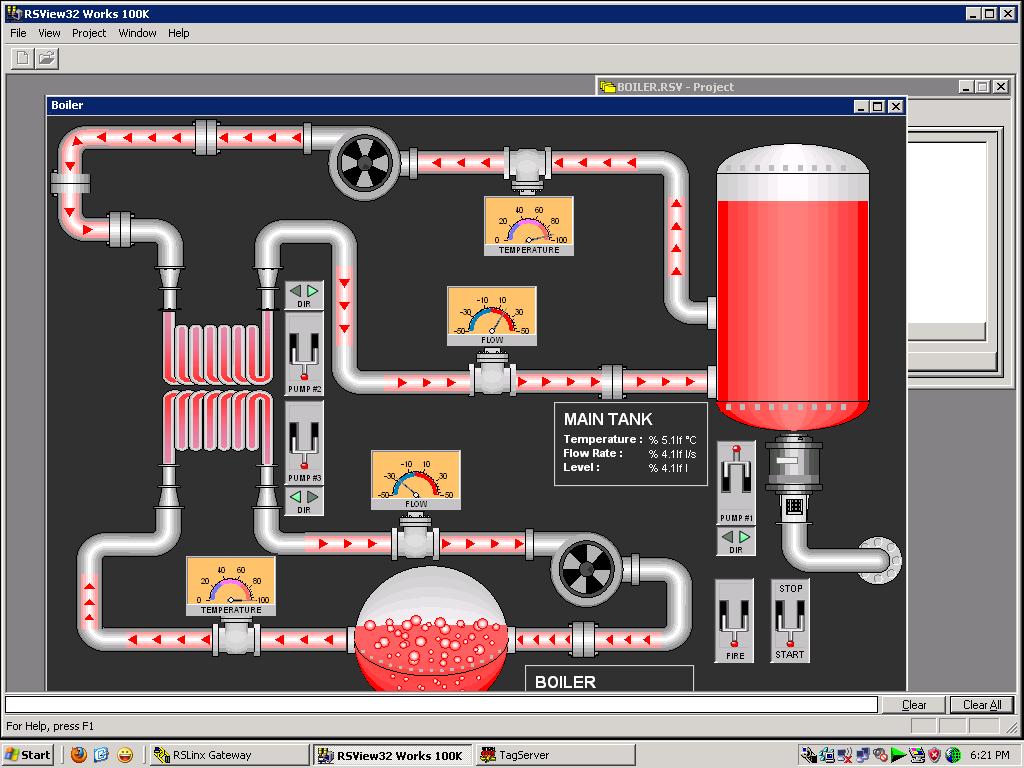
Small actifities post cardia surgery. Boiler HMI using RSView32, porting from WinlogLite and Symfac 2.0 to GFX graph, rewrite all tags / derived tags. All tags type converted to DDE tags. RSLinx role as DDE server ;)

Monday, October 10, 2011

Losses in a Transformer

The Efficiency of the transformer is the given by

(Power output/Power Input)*100

The Efficiency of the transformer is affected by the losses inside the transformer.

These losses can be categorized into three types
  1. Copper losses
  2. These are losses caused by the heating of the conductor when current is passes through it. They are also known as I*I*R losses as the heat generated is proportional to the formula H=I*I*R

  3. Core Losses
  4. Core losses are the losses which occur in the core of the transformer. There are two kinds of core losses, They are Hysteresis Loss and Eddy Current Losses

    • Hysteresis losses occur when the magnetic orientation of the molecules inside the core are reversed when the magnetic field changes. This reversal of orientation of the molecules results in the generation of heat.

    • Eddy current losses occur due to circulating currents in the form of eddies which are generated in the core. These eddy currents generate heat.

  5. Stray losses
  6. These are losses which occur due to the leakage of the magnetic flux of the transformer. This leakage can cause eddy currents in the fitments of the transformer such as the tank, channels, bolts, etc.

Monday, September 12, 2011

The combustion Losses in Boiler

When the fuel is burnt in the furnace of a boiler, all the energy in the fuel is not available to heat the boiler. Some of the energy is lost in the form of losses.

The Losses in combustion of a boiler are categorized in to the following types:
  1. Loss in the Flue gases
  2. The heat generated by burning the fuel is present in the flue gases. When these gases escape into the atmosphere, some amount of heat also escapes with the gases.

  3. Hydrogen Losses
  4. This refers to the heat used in evaporating moisture or water present in the fuel. This is particularly significant in coal-fired boilers.

  5. Losses due to improper combustion.
  6. The improper combustion of fuel due to poor quality or inadequate air also results in loss of potential energy

  7. Losses due to Convection and Radiation
  8. The furnace of the boiler is insulated. Despite this, some heat escapes from the furnace to the atmosphere.

Monday, August 8, 2011

Draught in Boilers

Draught or Draft refers to the pressure difference between the burner and the atmosphere. This pressure difference or draught causes the air to flow from the burner to the atmosphere. The residue of combustion such as waste gases, soot, etc are carried away by the flow of air.

Draught also has a great role to play in combustion. The flow of fresh air into the burners is necessary for proper combustion. Hence, the draught system should be designed such that the combustion can take place properly.

The draught of a combustion system can be measured using a manometer when the furnace is in operation. One end of the manometer is connected to the furnace while the other end is left open to the atmosphere. The pressure difference indicates the draught of the system.

There are different types of draught:
  1. Natural Draught where the draught occurs naturally due to the pressure difference between the furnace and the atmosphere.
  2. Induced Draught where the draught occurs by means of fans which create a negative pressure in the furnace causing fresh air to enter
  3. Forced Draught where the draught occurs due to fans which provide combustion air and create a positive draught in the furnace. This drives the air through the chimney

Thursday, July 7, 2011

Hammering in Boiler Systems

Water present in a steam system moves at a very high velocity driven by the steam pressure. In some cases, the acceleration is even greater than that of steam. When this water at high speed hits a fitting such as valve or a bend, violent impact resulting in noise or a pressure shock which travels through the system is produced. This is called water hammering

Mild cases of water hammering can cause noise or vibration. Extremely severe cases can result in fracture of the pipe.

Condensate Hammering is more damaging than water hammering. In condensate hammering, a pocket of steam surrounded by cooler water condenses into water. This causes a rapid reduction in volume. The water surrounding the pocket are thus drawn inwards and a collision occurs. This results in a severe a rapid over pressurization which can easily damage gaskets, valves and other components. The consequences can be very disastrous even fatal.

Hammering can be removed by preventing water from entering the steam lines. Reducing Carryover, ensuring that the steam traps are functioning properly are some of the precautions. The steam velocity in a boiler should not be allowed to exceed limits. Steam velocity has a direct bearing on the intensity of the hammering.

The piping should be as per design. Sagging of the pipeline can cause water hammering. Damaged insulation can cause condensate formation in the pipelines. Insulation should be checked and replaced if damaged.

Monday, June 6, 2011

Membrane Contactors

Membrane Contactors are used to deaerate water in a boiler. Membrane Contactors are getting increasingly popular. Membrane Contactors use a membrane which is made of hydrophobic material with pore size of the order of 0.03 micrometer.

On one side of the membrane, a gas, usually nitrogen, is passed at low pressure. On the other side, the water to be deaerated is passed. Since the membrane is hydrophobic, the water does not pass through it. But the gases which are dissolved pass through the membrane to the other side with low pressure.

The deaeration process can be controlled by varying the pressure of the gas and its concentration. The capacity of the contactor can be increased by adding more membranes. The membrane contactor method can produce water with a dissolved oxygen concentration of less than 1 ppb (parts per billion).

The advantages of using Membrane Contactors are:
  1. Absence of Emulsions
  2. No Flooding even at high flow rates.
  3. No density difference between the fluids is required.
  4. High surface areas

Thursday, May 5, 2011

Deaeration of Boiler Water

Deaeration refers to the process of removing dissolved gases such as oxygen and carbondioxide from the water. Dissolved Oxygen in Water causes corrosion by the formation of rush on the surfaces of the boiler and the piping (rust). Carbondioxide which is dissolved in the water forms carbonic acid which also causes corrosion.

Hence, it is essential that these two gases are removed from water. Deaerators can be classified into:

  1. Mechanical Deaerators:

  2. These Deaerators separate the gases by a mix of high temperature and mechanical action

  3. Chemical Deaerators:

  4. Chemical deaerators work by passing the water through chemicals which absorb the oxygen and the carbondioxide.

  5. Vacuum Deaerators

  6. Membrane Contractors:

  7. Membrane Contractors work by passing the water through hollow fibres. The water is made to pass on the outside of the hollow fibre. A vacuum is created on the inside. The gases pass through the membrane on to the inside and drawn into the vacuum pump.

Monday, April 4, 2011

The Day the Rankine Closed


Sebuah catatan reflektif seorang thermal engineer yang kini menjadi Kepala ICT

Suatu masa di 2011 . . .

Setiap perjalanan insinyur dimulai dengan noise. Di hari-hari awal, diagram T–s tampak seperti peta yang menolak bersahabat: garis keluaran turbin meloncat ke udara, superheating tidak pernah menapak pada kondenser, dan enthalpy inlet–outlet tidak pernah menutup sempurna.

Setiap titik menjadi tanda tanya. Dan setiap kali tombol Run ditekan, PC Desktop mengingatkan dengan dingin:

“Energy balance not achieved.”
Namun yang tidak dikatakan oleh software itu adalah — kesabaran juga bagian dari perhitungan.


1. Fase Debug — Menyelami Jalur Energi

Hari-hari itu saya habiskan di antara angka dan keringat. Satu per satu node saya buka: feedwater heater, deaerator, low-pressure heater. Saya periksa mass flow, saya tetapkan nilai xoutlet di sisi kondensasi. Tidak ada yang instan di dunia termodinamika. Bahkan energi pun, sebelum berpindah, harus berdamai dengan tekanan dan suhu sekitarnya.

Perlahan-lahan, titik-titik itu mulai berbicara. Saya mulai mendengar pola — bukan lagi angka, tapi ritme: bagaimana uap memberi panas, bagaimana cairan menerima, bagaimana setiap kilojoule kembali ke asalnya tanpa tersesat.


2. Fase Penutupan — Kesempurnaan yang Sunyi

Dan akhirnya, di suatu sore, setelah sekian jam iterasi, saya menatap layar dan melihat garis itu menyatu: kurva uap yang turun lembut ke garis jenuh cair. Tidak ada perayaan besar — hanya keheningan, dan sebutir kepastian kecil: bahwa hukum pertama termodinamika telah ditegakkan.

GPHR dan NPHR kini punya makna, bukan sekadar angka di laporan, tapi cermin dari keseimbangan — antara energi yang keluar dan energi yang pulang. Itu hari ketika siklus Rankine saya menutup sempurna. Dan di momen itu saya sadar:

“Siklus ini bukan sekadar mesin,
tapi alegori tentang kehidupan.”

3. Epilog — Dari Uap ke Data

Kini saya tidak lagi menghitung kalor, melainkan bit, bandwidth, dan uptime. Namun setiap kali saya melihat arsitektur jaringan yang stabil, saya masih melihat siklus Rankine di baliknya: Server sebagai boiler, router sebagai turbin, database sebagai deaerator, user sebagai kondenser. Dan di pusat semua itu, ada hukum yang sama:

Tidak ada sistem yang sempurna,
kecuali yang seimbang.

Dulu saya menyeimbangkan uap dengan air; sekarang saya menyeimbangkan manusia dengan mesin. Dan saya tahu, prinsipnya tidak pernah berubah.


Penutup

Sempurna bukan berarti tanpa kehilangan, tapi ketika semua kehilangan telah kembali menjadi energi lain.

Begitulah hidup seorang insinyur — selalu berputar, selalu menyeimbangkan, dan selalu berharap, setiap siklus yang ia rancang menjadi sedikit lebih selaras dengan Sang Pencipta Energi itu sendiri.

— Chief-ICT, JCM
(engineer termal yang masih percaya bahwa setiap siklus, termasuk kehidupan, harus ditutup dengan keseimbangan)

Thursday, March 3, 2011

It is simply beyond our senses, thought, logic, and comprehension

As reiterated time and again by those brilliant brains, this invented supreme creator is simply beyond our senses, thoughts, reason and comprehension. We are the lowly creatures, with a limited capability to understand the creation and existence. If this is the truth, then why do we keep trying to understand it? There are much more productive areas to direct our efforts which would produce results.

The results, expected from the research in genetics, and especially the human genome project will provide us with tremendous possibilities to raise our level of intellect towards that of the supreme creator(!). This will put us in a position to understand how the mankind has duped itself. These scientific developments will show us also a much more clear picture of our existence than the debate on the supreme creator.

Wednesday, February 2, 2011

Intellectual Efforts To Prove The "UN-Proveable"

Since its invention by the human imagination this has been a matter for the resolution of which a great deal of intellectual resourcefulness has been put to trial. Problem was and still is to find an explanation to the inexplicable, and proving the un-provable. It is boring in the sense that there is no end to it. It is definitely not of this world because no one has seen or heard or witnessed anything about the supreme being, that could bring a pinch of reality to it. All efforts have been fruitless since its inception 6000 years ago, but nevertheless it continues to be the most favorite pastime of the incognizant minds. The ideas invented by the mankind and the belief systems built around those ideas have been the source of many problems both in the personal and public spheres. They are the instruments of sovereignty, division, oppression, and injustice as well Since the beginning belief systems have also pushed women into a secondary position in their respective communities. Look around yourself and you'll most certainly come face to face with the characteristic examples.

The brightest brains were involved in the debate to solve the mystery. To no avail. The crucial questions asked thousands of years ago are still valid, and unanswered. Those brains that took part in the discussion have made themselves fall into the trap set up by the inventors of this fiction. Some of them have tried to prove that this invention has really existed while others have tried to show that it is all nonsense. There are always different sides in a discussion. But if the subject of the discussion is an 'unknown' how could one be for or against it positively? We shall not fall into the same trap of discussing the incomprehensible with the terms set by its inventors. This is especially crucial when one remembers all those brilliant brains which were stalled by the stalemate, ending up in rejecting the invention itself. We shall ask the right questions. Each question will show that not even a single step has been taken towards the supposed reality. But too many things have been said and written. As we try to follow the story of the supreme being we shall have glimpses of the frail human mind's efforts to solve the riddle that it has created.

This problem was introduced by the human beings, was it not? Now the ones who are trying to find a solution are also the human beings: Allegedly the limited, the incapable creatures of supreme being. Being limited by creation and incapable of full comprehension of the reality, the mankind felt that it needed answers to the questions about the creator it has invented. The next step was the need to establish the nature, intentions and activities of this creator. This, in turn, has introduced the following crucial questions:

  • Why did this supreme being create the mankind?
  • What is the (imaginary) role given to mankind by this supreme being?

All these efforts ended up in the fall of the mankind to the level of incapability, and the slowing down of the human progress. Thanks to the tremendous achievements in science and technology, situation has changed, and the movement is gathering pace.

Saturday, January 1, 2011

Firmware Kesadaran dan Ritual Kopi Pagi

(Catatan Chief-ICT di bawah cahaya neon kantor)

Setiap pagi, ada dua proses booting yang berlangsung bersamaan: yang satu di dalam server, dan yang satu di dalam kepala manusia. Keduanya sama-sama membutuhkan waktu, listrik, dan kopi. Bedanya, server tak punya pilihan, sementara manusia punya tombol snooze.

⚙️ I. POST — Power On Self Test

Saat mata terbuka setengah, tubuh menjalankan diagnostic sequence. Apakah ini hari kerja? Apakah aku masih hidup? Apakah alarm itu nyata? Dan di titik inilah kesadaran mulai muncul — bukan dari sinar matahari, tapi dari sinar layar ponsel yang menampilkan notifikasi tak berujung.

System check: OK
Wi-Fi: Reconnecting...
Motivation: Missing driver
Mood: Needs caffeine injection
☕ II. Initializing Caffeine Interface

Tak ada protokol yang lebih universal di dunia profesional selain: kopi pagi. Kopi bukan sekadar minuman, tapi ritual sinkronisasi antar dimensi. Di antara kepulan uapnya, Chief-ICT menemukan waktu untuk introspeksi: berapa tiket IT yang belum direspon, berapa RAB yang belum disetujui, dan berapa vendor yang akan datang tanpa janji lalu minta rapat pagi.

Kopi adalah API antara dunia mimpi dan dunia kerja. Ia menyalakan port “kesadaran” dan membuka socket komunikasi dengan realita.
💻 III. System Online — Masuk ke Kantor

Begitu badge di-scan dan pintu terbuka, firmware kesadaran berubah menjadi OS penuh. Wajah-wajah rekan kerja bermunculan seperti ikon desktop: Finance.exe, HRD.bat, VendorUpdate.cmd, dan BoDMeeting.iso. Setiap klik adalah potensi crash, setiap sapaan bisa menjadi patch yang menunda kelelahan.

“Selamat pagi, Pak.” — “Pagi. Sudah di-approve ya RAB yang kemarin?” Dan begitulah, debugging dimulai bahkan sebelum kopi habis.
🔧 IV. System Maintenance — Di Bawah Cahaya Neon

Ketika malam datang dan kantor kosong, hanya satu makhluk yang tersisa: Kepala ICT yang masih menatap layar sambil berkata lirih, “ini bukan lembur, ini maintenance spiritual.” Ia sadar — sistem boleh auto-update, tapi manusia tidak.

Setiap baris kode adalah doa kecil agar dunia tetap stabil.
Setiap log error adalah pengingat bahwa bahkan mesin pun butuh pengampunan.
🌙 V. Shutdown Sequence

Dan ketika lampu neon padam, dan kursi diputar perlahan, Firmware kesadaran kembali tidur, menunggu panggilan alarm besok pagi. Semoga patch hari ini cukup untuk memperbaiki bug kemanusiaan yang tersisa.

System shutting down…
See you again, Monday morning.
Hopefully after only one snooze.

Sunday, December 12, 2010

When Did History Begin?

You must have heard the statement that 'history has begun at Sumer.' The evidence we have today indeed show that it actually had begun between 4000-1000 BC.; If history had started with writing then the first page was written in Mesopotamia about 6000 years ago!

Sumerians started keeping record of their times in the form of pictograms on clay tablets, and around 3000 BC. a form of cuneiform writing and a full syllabic alphabet appeared. Peoples in the neighbouring lands has adopted, amended and used this alphabet according to their needs.

Thursday, November 11, 2010

sparks of reflection

Do you know why the windshield of a car so big and rearview mirror of a car so small? Because our PAST are not as important as our FUTURE. Look to the future and move forward!

Sunday, October 10, 2010

Superior Beings aka Out-of-this-world entities, so called "divine" beings

They are "superior" because human beings consider themselves inferior and powerless in the face of the natural phenomena almost all of which either originate from the skies or the result of atmospheric events. Sky is "up there." The force of aerial phenomena is "overwhelming."

There must be "something" or "someone up there doing all this to the earthlings living down on the earth." Furthermore the earthly phenomena like earthquakes, volcanoes, eruptions and subsidences, possibilities, probabilities and chance all come together and create this idea of "superior beings."

Thursday, September 9, 2010

At the root of faith we have incomprehensibility, perplexity, obscurity, ambiguity, mystification (choose the one you please)

Those who wrote down the rules of the faiths did it intentionally. What did the believers do? They just believed, and they still do, because none of the supposed facts of faith is clear. So the believers had no choice but to take the stories for granted. They had no choice because they needed something and the faith has provided for their needs. They had no choice because the whole thing was an enigma, and the best thing seemed to be to believe without questioning.

Sunday, August 8, 2010

Manifold


Manifold is an object that has no end or limitation but not an infinity, but closed like a globe shape and has no sharp curves or surfaces. Which are algebraic manifolds, is also the geometry objects that can be expressed in the equation. Simple illustration: x²+ y² = 1 is a circle, while xy = 1 is a form of hyperbola.


Wednesday, July 7, 2010

Smart Valve Control

another smart valve control, using microsoft visual basic 3.0 and electronic interfacing. Well, I build this model (1998) using stepper motor (for valve control) and LDR for sensing the fluid inside the tank.

Sunday, June 6, 2010

Are you sure what you know is right?

What is the western perception of primal religions? What do you know about these primitive societies and their beliefs? Let's find the answers by citing those examples (The Elements of World Religions, Liz Flower) which will take us on our road to the sole God: The popular belief is that primal religions are animistic, ancestor-worshipping, sacrificial, fetishistic, ritualistic, shamanistic, superstitious, and polytheistic. But the truth is rather different.

Most of these tribal and primal societies have a very strong social structure. And much of their religion is based on that structure. Dignity in life and death is paramount. Morality is conformation to traditions. Everything has a particular reason, everything has its place. They have a surprising tolerance. Most communities recognize that their belief is theirs, and do not necessarily involve the community next door. There are differences of course. We come across a plurality of beliefs, myths, cosmologies and rituals.

The bottom line is: There is a strong social structure.. Religion is based on that structure.. Dignity is paramount.. Everything has its reason.. Everything has its place.. There is tolerance to other beliefs.. Everything sounds more natural and simpler than today.

Which is better? Today's speculation and ambiguity or their simplicity?

Although there are great differences, the primal religions worldwide have originated from a half dozen basic beliefs. Majority of the primal religions are monotheistic. Surprised? All of them have a fundamental belief in the power of spirits. There is ancestor worship/reverence in the majority of primal religions. A kind of prayer, gifts, and sacrifice exist in most of them. There are also a medicine man and a shaman or a witch doctor. Lastly, majority of these primal religions have celebrations of a new season or a new year.

Wednesday, May 5, 2010

I miss this things

what an old 6200 mix_plant in the new old face RSLogix :)
First time I wrote the program using AI 6200 Logistic, paired with WinLinx and RSView32 back in 1997 — running on a Windows 95 box that hummed louder than the panel cabinet itself. Every rung, every coil, every timer was typed line by line, no drag and drop, no tag browser. Just pure ladder logic and patience.

In those days, uploading to a PLC-5/40E felt like talking to a living thing. When the RUN light blinked steady, it meant trust. When the outputs latched without fault, it meant pride. And when the whole plant came alive — pumps roaring, mixers humming, the mimic diagram dancing green and red — that was the sound of achievement.

I remember carrying a long serial cable, connecting to the processor through DF1, and holding my breath each time "Comms Initialized" appeared on screen. There were no cloud backups, no version control — only floppy disks labeled by hand and the quiet faith that Mr. Never Fail would live up to his name.

Seven years later I reopened the same project in RSLogix, RSLinx and RSView. It was like meeting an old friend wearing a new uniform — the same logic, same heartbeat, but wrapped in a Windows UI. I think no one remember about old AI 6200 Ladder Logistic anymore, but for some of us, those green lines and square coils still whisper stories of the factory floor — of engineers who coded with patience, coffee, and courage.


EDITORIAL NOTE 2025:

This editorial note was written thirty years after the first rung compiled. When logic met learning, and code found consciousness.


In those silent years between relay hums and AI prompts, the language of control never truly changed. It only learned to dream. What began as ladder rungs — drawn with patience, current, and purpose — has now become a living syntax that flows through neural networks. Yet beneath all the abstraction, the rhythm is still the same: input, process, output.

Back then, engineers spoke to machines with timers and coils; today, we speak through algorithms and embeddings. But both are acts of trust — that somewhere within the circuitry, logic will awaken and obey. The console may have changed, but the devotion remains.

This note marks not an ending, but a resonance — a quiet echo from the age of AI 6200 Logistic to the dawn of artificial intuition. The same faith that powered a PLC-5/40E still hums within today’s silicon minds. Only the interface has evolved — from rungs to reasoning, from logic to learning.

— Written in 2025, by an engineer who still believes that even in the age of AI,
every line of code is a conversation between man, machine, and memory.


When Ladder Met AI

It has been decades since I last opened that old mix_plant project. The smell of flux solder, the hum of a 24VDC bus, the flicker of a CRT monitor — all still alive somewhere inside my memory. Back in 1995, I wrote my first complete control program using AI Ladder Logistic 6200, a DOS-based world where every rung was typed like a prayer, and every compile felt like lighting a candle for the machine to understand.

By 1997, I migrated everything to the all-Windows environment using RSLogix. It felt like civilization itself had taken one bold step forward. The gray screens turned to color, the ladder symbols glowed smoother, and my old PLC-5/40E stood proud, breathing through WinLinx and RSView32. I didn’t know it then, but that was the beginning of my own digital awakening.

Those were the days when automation was an art form — not drag-and-drop, but discipline and instinct. I still remember mapping input bits to production databases, linking process variables into Planning Production Control, and writing early GUI panels so that the Control Room could speak to the Directors’ Office upstairs. Each connection was a bridge between worlds: the noise of relays below, and the quiet hum of decision-making above.

We didn’t call it IoT back then. We just called it “making things talk.” The PLC spoke to the PC, the PC spoke to the operator, and somehow — through logic and patience — the entire plant listened.

Now, in the age of cloud and AI, I sometimes open that same ladder again. It still compiles. It still runs. Only now the hum of the processor is replaced by the whisper of a neural net. But deep down, the feeling is the same — that quiet pride of giving structure to chaos, one rung at a time.

— Written by someone who still believes that Ladder Logic is not just code, but poetry drawn in electric lines.

Sunday, April 4, 2010

VB 3.0 Heat and Mass Balance for Deaerator

This program developed using Visual Basic 3.0 for calculate the deaerator of small scale CFSPP's heat and mass balance. The variable inputs are:

  1. Pressure [bar]
  2. Temperature [C]
  3. Deaerator efficiency [%]
Calculation results are:

  1. Steam Flow required from high pressure pipe (from turbine)[kg/s]
  2. Water Flow required from LP Heater [kg/s]

and also calculate The Steam and water properties:

  1. Enthalpy [kj/kg]
  2. Steam_flow [kg/s]
  3. Specific Volume [m3/kg]
  4. Specific Entropy [kJ/kg.K]
  5. Internal energy [kJ/kg]
  6. Dynamic Viscosity [kg/m.s]
  7. Thermal Conduct [W/m.K]

Wednesday, March 3, 2010

Strategies to Developing SCADA Security

Development of the industry, makes more complex problems faced related to control systems and security. In general, SCADA is still relevant enough to be used as a control system that is capable of controlling several machines control in different areas. In line with the increasing fragility of attacks against SCADA cyber attack that also need proper treatment.

SCADA security systems today require the integration of several functions of controllers such as firewalls, proxy servers, operating systems, coating application systems, communications, and policies and procedures. For the implementation of SCADA security strategy then you need security measures to keep the network as follows:

Strategies Developing SCADA
  • Border Router and Firewalls
  • Cyber ​​attacks are usually carried out by sending the software to penetrate the internal private network. If the security system is not protected SCADA Firewalls are configured correctly then your security system is not good enough to protect passwords, IP addresses, files and so on.

  • Proxy Servers
  • Packets of data sent or passing through TCP / IP should have been entered in the resource control layer applications such as Hyper Text Transfer Protocol (HTTP) and Simple Mail Transfer Protocol (SMTP). To strengthen the security system SCADA proxy server acts as a firewall to protect the traffic between a protected network and the Internet. These systems are relatively safe although security with proxy servers will not eliminate the threat of the layer attacks application.

  • Operating Systems
  • As the brain of the computer system, the operating system became the main target of cyber attacks. There are 2 options for securing this system namely through the operating system upgrade to newer versions or migration by replacing opeating system to a higher version. For the safety of Operating Systems should really upgrade to the latest version and there is no compromise for any irregularities that exist.

  • Applications
  • Some viruses are intentionally sent to undermine the security of SCADA systems such as buffer overruns, worms, Trojan Horse, Active-X5 codes, and other malicious programs that we need to anticipate. Viruses and works by paralyzing anti-virus software and bypassing the firewall as if it had no security protection there

  • Policies and Procedures
  • In addition to programs designed to address cyber attacks, it is necessary also the policies that govern the discipline of the user in performing the procedure. The policies and procedures include the selection of a secure password with a combination for example with at least one symbol, a capital letter and a number, and should be more than eight characters.

  • SCADA Firewalls
  • SCADA network security can be strengthened with layers of firewalls between the system SCADA network and the Internet. System security threats are often due to internal factors such as the employee who accidentally did not record the procedures performed and it turns out it can be compromised using the hacking method that is similar to what he did.

  • SCADA Internal Network Design
  • Internal SCADA network must have its own IP and run by using intelligent switches and sub-masking techniques appropriate to protect the system from cyber attack. The use of Ethernet Wireless and Wired Equivalent Protocol (WEP) can be an alternative to change the default name of the Service Set Identifier6 (SSID).

Conclusion

Supervisory Control and Data Acquisition (SCADA) system is the important control processes in many countries. This system performs important functions vital to many companies such as electric power companies, gas - natural, petroleum, water treatment, sewage treatment, and even the railway. However, considerations in terms of safety in the design of this system have received less attention, so the potential for interference from unauthorized access can occur. This review above will provide you several important phases to protect your system from cyber attack. By learning more methods you will get alternatives and the implementation of effective and economical control system.

Tuesday, February 2, 2010

Superheated Steam

Superheated Steam is steam which does not have any water droplets. When saturated steam is heated, the water droplets which are suspended get converted into steam. Superheated steam is also called dry steam. Superheated Steam is used to drive turbines.

Superheated steam has a lower density and higher temperature.

The main advantage of superheated steam is that there are no droplets. In turbines, where the steam moves at high velocity, any water droplet which hits the turbine blades can seriously damage the blades or cause corrosion.

Superheated Steam can store large quantities of internal energy and can release them during expansion. This is utilized in turbines. Superheated Steam has higher change in specific volume when it cools. This enables better efficiency in turbine operation.

Superheated Steam has low oxygen. Hence, there is a reduced risk of corrosion in components using superheated steam.